
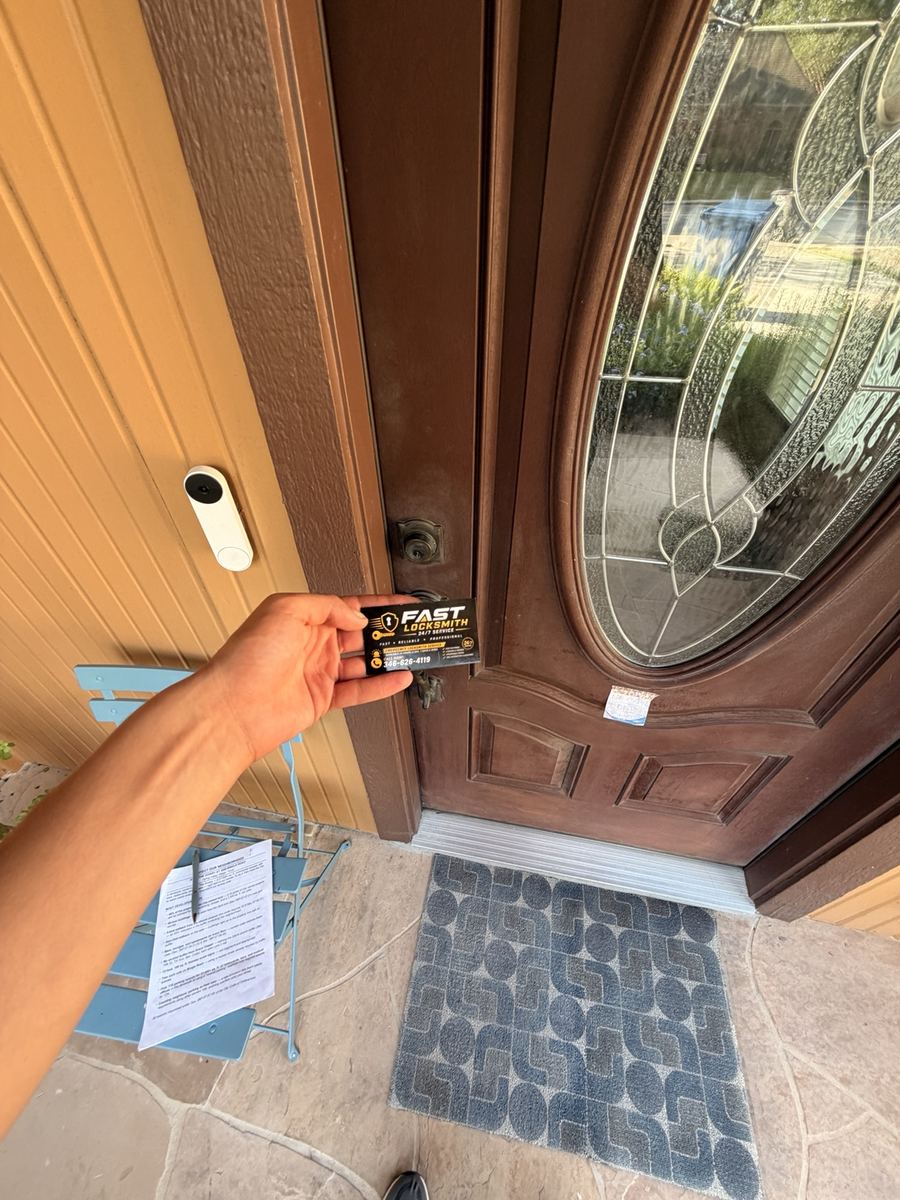
Rekeying is usually scheduled. If you need it before a new tenant arrives a technician comes.
A plain tip: count your doors and your unknown keys before the visit. The number often surprises people.
A Duplex, Five Doors and the One Cylinder That Didn't Belong
Technicians learn to read a property by looking. Here's a typical example, through the technician's eye, from a rental duplex that was between tenants.
The technician stopped on the front walk and looked at the doors before he went inside. There were two units, each with a front door and a back door, and the landlord had said five locks needed rekeying. He counted six cylinders, because the garage entry for the left unit had its own. He looked at the brass: four were one brand, one was another, and the garage lock was a third, with a keyway shaped differently from the rest.
The landlord had called earlier. Our dispatcher asked the straight questions. Was the property empty and safe? Yes. How many doors? Five, he thought. Did he want them all on one key, or one key per unit? One per unit. Did he have proof of ownership? A deed on his phone and his license. She said a technician was heading over.
The technician showed his ID and compared the landlord's license with the deed. He told him there were six cylinders, not five, and that the garage lock had a different keyway. Rekeying it to match the others wasn't possible. The landlord scratched his head and admitted he had never counted the garage lock at all, since it had always been the tenant's concern. The technician said that was how most properties ended up with a stray key or two. The technician set up on the front step with his kit and rekeyed the front and back doors of the left unit first. The first pass at the garage lock confirmed it: the pins wouldn't take the same cut.
He offered two options. He could swap the garage cylinder for one in the shared keyway, or leave it as its own key. The landlord chose the swap. The new cylinder worked on the second try, after the technician filed a burr off the cam. He tested all six locks, made two keys per unit and labeled them. The straight advice: walk your property with a pen before you book, and count cylinders, not doors.
Rekeying a Rental, Door by Door
Rental Turnover Rekey
A rental turnover rekey changes the keys between tenants.
Mismatched Keyways
Mismatched keyways are a common surprise. A lock with a different keyway can't join the rest of the set without being swapped.
A Single Key Across the Whole Unit
One key for every door cuts down on the ring. We match cylinders where the brands allow it.
Duplex Rekey
A duplex rekey usually means separate keys per unit and one shared key for common doors. We label each set.
Counting Cylinders
Count cylinders, not doors. A garage entry, a side door or a storage room may each hide its own lock.
Ringing a Rekey Locksmith
A rekey locksmith near me call needs your address, number of cylinders and, if you know it, the lock brands.
Swapping an Odd Cylinder
When one cylinder doesn't fit the set, we swap it for one that does.
Labeling the New Keys
We label each new key by unit and door, so the next tenant gets the right set.
Landlord Papers
A deed, lease or management agreement, plus a photo ID, confirms you can authorize the work.
Spare Sets for the Manager
A second set for the property manager can be cut at the same visit.
Keeping a Key Log
A key log lists each door, its lock brand and who holds a key. It takes a few moments to write and saves hours later.
Fitting Around Your Turnover Date
Our technicians work from vans across Spring, so the tools come with them. Rentals across Spring are regular stops. Landlords with several units can book one visit for all of them, and we plan the route to keep the day short.
Straight Answers From a Technician Who Looks First
He comes in uniform with a photo ID clipped where you can see it. He counts the locks, explains what he sees and tests every key before leaving. He labels the new keys with a code and writes the same code in his notes, so a later copy matches the right door.
You get a licensed, insured crew, backed by a 5-star Google rating from Houston-area homeowners.
Rekey Service Around Spring
Rekey service in Spring comes from landlords, new owners, families after a lost key and anyone who wants a clean start. Many calls come at the end of a lease, when the previous tenant's keys are still out there.
Property managers with several units can ask for a master arrangement: one key for the manager, one key per tenant. It takes planning, and we explain the trade-offs. A simple system that gets used is better than a clever one that gets confused.
New owners benefit from a rekey in the first week. Previous owners, agents, inspectors and contractors may hold copies. A fresh set of keys makes the house yours.
Landlords in Spring often manage a handful of properties, and the same question comes up each turnover: do I change the locks or just the keys? Rekeying answers it for most. The locks stay in the doors, the pins inside change and the old keys stop working.
A good rekey also lets you design the key system. One key per unit with a shared key for the laundry room or the mailbox cabinet is common. A master key for the manager is another. The more keys you add to a system, the more complicated it gets, so we recommend the simplest arrangement that fits how you manage the property.
Older rentals sometimes surprise us. A lock that was swapped years ago may share no parts with its neighbors. A cylinder that has been painted over refuses to turn. A latch that was never lined up drags on the strike.
Keep records for each Spring property. A simple list of each door, its lock brand and the number of keys cut helps at every turnover. When a tenant says they lost a key, you know what you have and what you need. We'll leave you a short list at the end of each visit to get you started.
Tenants appreciate a quick turnover too. A unit with a fresh key on move-in day starts the lease with trust. If a tenant locks themselves out, and a short written note saves an argument. Whatever you decide, keep the policy in writing and apply it the same way every time. It protects you and the tenant.
Rekeying between tenants also gives you the chance to look at each lock, each strike and each latch, so you catch wear before a tenant reports it.
Rekeying changes the inside of a lock so old keys stop working. It suits a house that has changed hands, a newly built house where crews held keys, or a home where a long-forgotten copy might still be out there.
Gather the keys you have and list the locks to rekey. We can set several to one key so you carry fewer.
If a lock is worn or damaged, the technician will tell you. Rekeying keeps good hardware and is not the answer for every lock.
Ask whether any lock should be left alone. A rarely used side door can share the new key or stay on its own.
Hand out the new keys before the old ones stop working, so nobody ends up shut out on the first night.
We rekey homes in Tomball, Klein and Humble too. If a lock is worn out, see lock replacement; for a full change, lock change service.
Estimated Technician Arrival Time
Arrival times vary depending on your location and technician availability.
Actual arrival time may vary depending on your exact location, traffic conditions, time of day, current demand, and technician availability.
Providing your exact vehicle location when calling allows us to give you a more accurate estimated arrival time.