
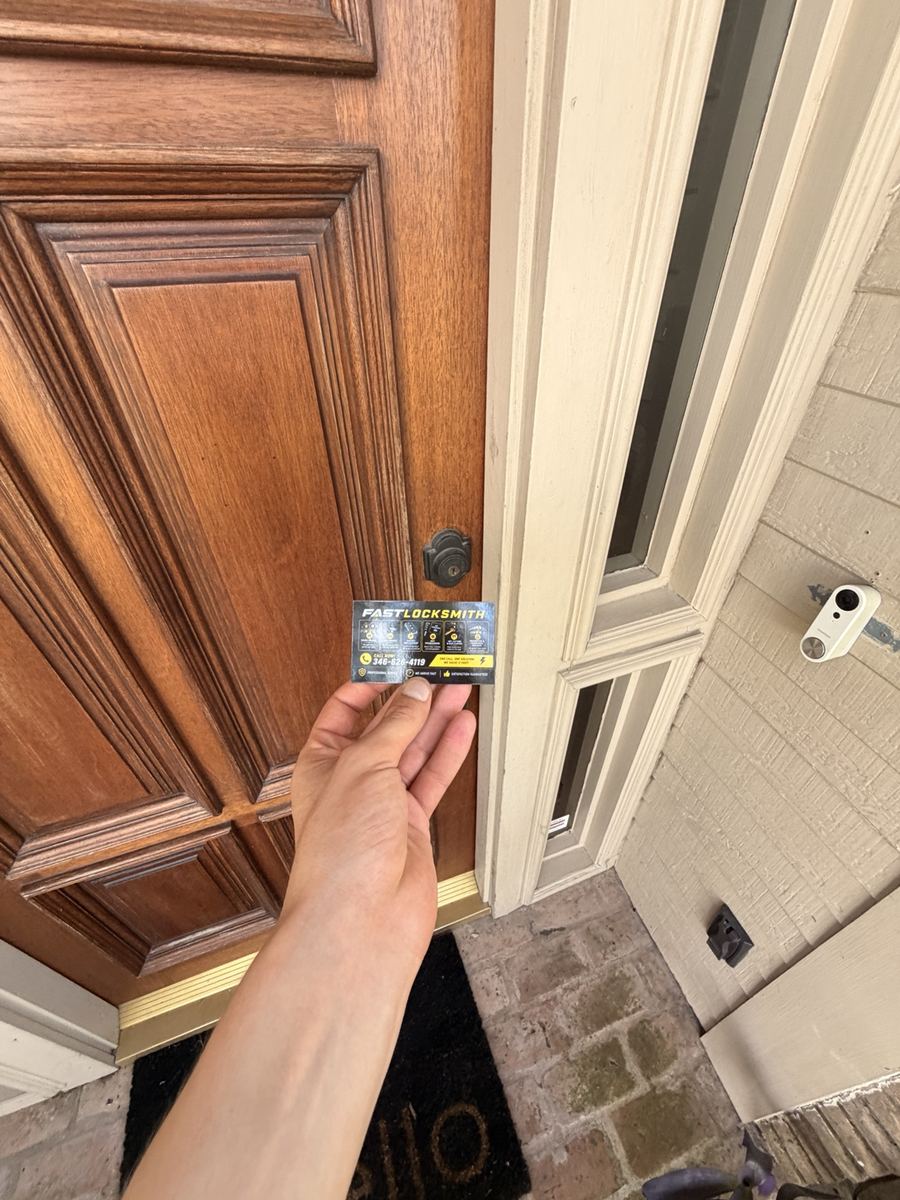
Deadbolt work is scheduled. If a door can't be locked tonight, a technician comes.
A planner's habit: measure the door's thickness and check whether it's solid or hollow before choosing hardware.
A Phone Call, a Tape Measure and Two Doors Planned Before Anyone Drove Over
Good planning saves a second trip. Here's a typical example of a call from a house off Sheldon Road.
A woman who had just bought her first house called on a weekday evening. The back door and the garage entry door had knobs only. She wanted deadbolts on both but didn't know what to buy or whether her doors could take them. Our dispatcher, who plans everything step by step, asked her to grab a tape measure and walked her through it on speaker. How thick was each door? The back door, an inch and three-quarters; the garage entry, an inch and three-eighths. Did the doors sound solid or hollow when knocked? The back door solid, the garage door hollow. How far was the knob's center from the door edge? Two and three-eighths on both.
The dispatcher explained that both doors could take standard deadbolts, but the hollow garage door needed a reinforcement sleeve so the bolt had something solid to sit in, and that both strikes should be set into the framing with long screws. She asked whether the doors should match the front door's key, which they should. The sleeve and the strike work, and booked a Saturday morning. She promised a text once the technician was heading over.
The technician, in uniform, showed his ID before anything else. He checked her license against the closing papers. He bored the back door with a hole saw and jig at the same backset as the knob, mortised the edge and fitted the deadbolt. The bolt didn't throw fully on the first try; the frame's pocket was shallow. He deepened it with a chisel, set a reinforced strike with 3-inch screws and tried again. Full throw. On the hollow garage door, he fitted the reinforcement sleeve before installing the deadbolt so the bolt and screws had solid material to grip.
He rekeyed both to the front door key with his pinning kit and showed her how far each bolt extended with the door closed. The planner's advice: measure before you buy, and plan the strikes along with the deadbolts.
Planning and Fitting Deadbolts
How to Measure Door for Deadbolt
How to measure door for deadbolt fitting: check the door's thickness, the distance from the edge to the center of the knob, and whether the door is solid or hollow. Those three numbers decide the hardware.
Door Thickness for Deadbolt
Door thickness for deadbolt hardware is usually an inch and three-eighths or an inch and three-quarters. Thicker doors need an extension kit.
Add Deadbolt to Back Door
To add deadbolt to back door slabs that have only a knob, we bore above the knob with a jig, fit the bolt and reinforce the strike.
Hollow Core Door Deadbolt
A hollow core door deadbolt needs a reinforcement sleeve so the bolt has solid material to sit in. Without it, the bolt can be pushed out of the door.
Deadbolt Installer Near Me
A deadbolt installer near me visit usually covers every knob-only exterior door in one trip.
Strikes on Long Screws
Strikes set with 3-inch screws into the framing are what make a deadbolt hold against force.
Same Key as the Front Door
New deadbolts are rekeyed on site to match your existing key.
Hollow Doors Between the Garage and the House
Garage entry doors are often hollow and knob-only. They deserve a sleeve and a deadbolt.
Homeowners and Renters
Owners book with ID and a deed or closing papers. Renters need landlord approval.
Checking the Throw
A deadbolt should extend about an inch into the frame with the door closed. We check it on every door. Check it with the door closed, not open.
Visits Across Channelview
We reach customers across Channelview with mobile technicians, not a storefront. Deadbolt work is scheduled at a time that suits you, often a weekend morning. Homes off Sheldon Road and Market Street are easy to reach on Saturdays.
Planners With a Tape Measure
The technician shows up in company uniform with ID in hand. They measure before drilling, reinforce hollow doors and test every bolt with the door closed.
Fast Locksmith 24/7 is licensed and insured, rated 5 stars on Google by homeowners across the Houston area.
Deadbolt Installation Around Channelview
Deadbolt calls in Channelview come from new owners of older houses with knob-only back doors, families after a break-in on the street, landlords securing rentals and homeowners replacing worn bolts. Deadbolt installation in Channelview often starts with a tape measure and a phone call.
Garage entry doors in Channelview homes are often hollow and lightweight, installed when the house was built. A reinforcement sleeve and a deadbolt make a big difference, and a solid-core door can follow later if you want more strength.
Deadbolts also matter on rentals. Landlords in Channelview often add deadbolts to knob-only back doors between tenants, keyed to a master the landlord holds.
If you already have a deadbolt that feels loose or doesn't throw fully, the problem is usually the strike or short screws in the trim. Reinforcing the strike often fixes it without replacing the lock.
Some owners want a keypad deadbolt on one door and keyed deadbolts on the others. They can all share the same key for the keypad's backup cylinder.
If you're adding deadbolts because of a break-in nearby, reinforce the strikes on every exterior door at the same time. The strike is where most kicked doors fail.
Doors with glass near the lock raise the question of single or double cylinder deadbolts. The technician will explain the trade-offs.
New deadbolts are sealed at the bore on wooden doors so humidity doesn't swell the wood around them.
If a door's frame is weak or damaged, a deadbolt alone won't hold. The technician checks the frame and suggests reinforcement if needed.
Garage entry doors leading straight into the kitchen or hallway are worth extra attention. A deadbolt there stops anyone who gets through the garage door.
If you're unsure which deadbolt to choose, the dispatcher can describe the options on the phone, from basic keyed deadbolts to keypads and heavier-duty models.
Some homeowners add a second deadbolt to the back door for extra strength, especially doors that face an alley or a field. The technician will explain whether it adds real security on your door.
Reinforcement plates around the knob and deadbolt bores are another option for older doors with thin edges. They help the door resist splitting.
A good deadbolt needs a good door and frame. Before fitting, we check that the door sits square, the hinges are tight and the strike has solid wood behind it.
Choose the grade that suits the door. Basic, standard and heavy-duty bolts differ in how they resist force.
Long screws in the strike do most of the work in a forced entry. We use ones that reach the stud.
Ask about a security plate around the lock edge. It is a thin steel cover that stiffens the door where kicks usually land.
Do not forget the back door and the garage entry.
Test the bolt again after a few weeks. New wood and hardware settle, and a small adjustment keeps it moving freely.
Homes in La Porte, Deer Park and Pasadena get the same work. New handle sets are a lock change; keypads are smart lock installation.
Estimated Technician Arrival Time
Arrival times vary depending on your location and technician availability.
Actual arrival time may vary depending on your exact location, traffic conditions, time of day, current demand, and technician availability.
Providing your exact vehicle location when calling allows us to give you a more accurate estimated arrival time.