
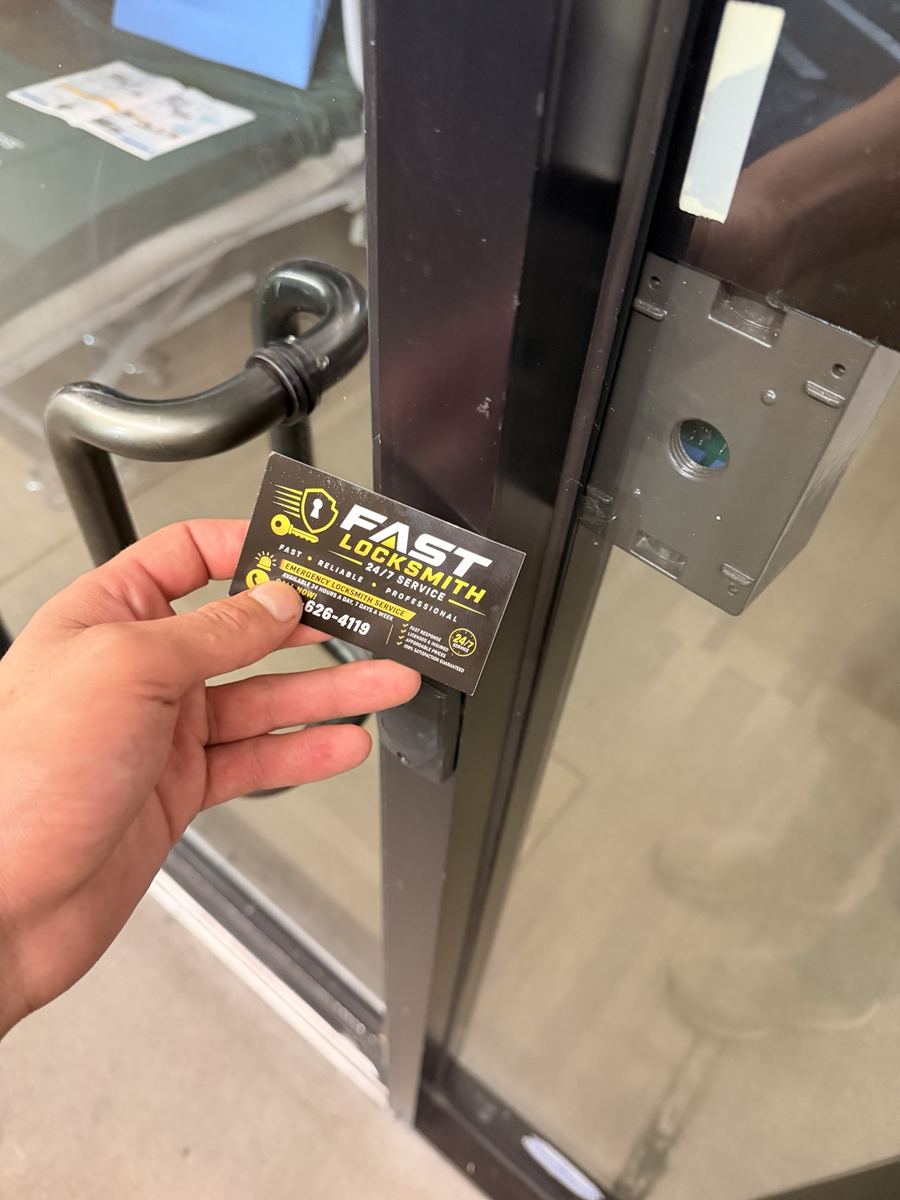
Most installs are planned.
A Narrow Deck Door, a Measurement That Changed the Plan and a Second Visit
Not every door takes a standard lock. Here's a typical example from a four-story townhome in Midtown.
A homeowner had a new door installed at the top of the stairs to his rooftop deck. The contractor left it blank. It was a narrow fiberglass door with a tall glass panel and a slim frame around the glass. He'd bought a standard deadbolt and lever set from a big-box store and called us to put them on, keyed to the front door, so he could finally use the deck without leaving the house unlocked.
The dispatcher asked for photos of the door's edge and face. The frame beside the glass looked narrow. She said the technician would measure before drilling and with a note that a narrow-backset lock might be needed. The visit was booked for the next morning; the technician would call when he was on the way.
The technician pulled up in uniform and introduced himself with his ID. He checked the homeowner's license against the address. Then he measured. The space between the door's edge and the glass was too narrow for the standard deadbolt's backset. Drilling there would have cut into the glass frame, and the lock simply wouldn't fit. The lever set had the same problem. He showed the homeowner the tape measure against the door. No guesswork. The homeowner had assumed a lock was a lock; he hadn't known there were different sizes.
So the plan changed. He recommended a narrow-backset deadbolt and a matching lever designed for slim doors, keyed to the front door. He ordered both and, in the meantime, fitted a keyed surface-mounted auxiliary lock high on the door, screwed into the solid top rail, so the deck door could be locked that night.
Three days later, he came back with the narrow-backset hardware. He bored the door with his jig at the shorter backset, set the latch and deadbolt, cut the strike mortises in the frame and drove 3-inch screws into the stud. He keyed both to the front door with his pinning kit. Then he removed the temporary auxiliary lock and filled its screw holes.
He tested both locks from inside and out, door closed, weatherstrip pressed. They threw cleanly. The homeowner returned the standard set to the store. The technician's advice: measure the door before you buy the lock.
How Lock Installation Is Done Here
Measure Before You Buy
Door thickness, backset, bore size and the space beside any glass decide which locks fit. A tape measure and a photo before buying saves a return trip and a ruined door. Send us both, and we'll tell you whether the hardware in your cart will work.
Narrow and Glass-Panel Doors
Deck and balcony doors often have glass close to the edge. Standard locks may not fit there. Narrow-backset deadbolts and levers are made for these doors, and we carry common ones or order them. Cutting a standard lock into a narrow stile weakens the door and can crack the glass.
Boring a Blank Door
Blank doors need a face bore, an edge bore and latch and strike mortises. New door lock installation with a jig keeps everything square, so the latch slides cleanly and the bolt throws fully. Freehand drilling is how most sticky locks start.
A Matched Pair on One Door
When we install deadbolt and knob or lever on the same door, we bore both at the right spacing and key them alike. They look like a set and work like one, and the thumb turn and latch line up the way the manufacturer intended.
One Key From Garage to Roof
Keyed alike locks put the front door, the garage entry, the balcony and the deck on one key. One key to carry, fewer copies to track, and a simpler rekey the day a roommate or tenant moves out.
Temporary Security Between Visits
If special hardware has to be ordered, we don't leave the door unlockable. A keyed auxiliary lock screwed into solid wood, or another secure temporary solution, covers the gap until the right parts arrive.
Tall Entry Doors
Tall front doors on newer townhomes may need longer bolts, multipoint hardware or extra hinge screws to stay aligned. We check the door's height and weight before choosing hardware, so the lock still lines up after a hot summer.
Doors Made of Different Things
Steel, fiberglass and wood each need different bits and drilling speeds. Done right, all three hold locks well. Done wrong, steel skins tear, fiberglass cracks and foam cores crush around the bore.
Offices, Studios and Storage Rooms
Small offices and studios in Midtown use keyed levers on storage rooms, office doors and back entrances. Door hardware installation for businesses uses commercial-grade parts that stand up to heavier daily use.
Who Can Book an Install
Owners can book directly. Renters need written landlord approval, and a text from the landlord usually does it. We check ID against the address before drilling.
Tested With the Door Closed
A lock that only works with the door open isn't installed properly. Every lock is tested closed, from both sides, with the weatherstrip compressed, before the technician packs up.
Where We Meet You in Midtown
Anywhere in Midtown, the technician comes to your car, your door or your gate. Installs are booked at a time that suits you, and the technician calls ahead. Midtown sits in the middle of everything, so it's usually a short drive. Weekday rush hour and weekend nights on Bagby are slower.
Technicians Who Measure Twice
Expect a uniformed technician carrying company ID. They measure, explain, install and test. If your hardware won't fit, they tell you before drilling, not after. They protect floors and finishes, and they sweep up the shavings before they go.
Fast Locksmith 24/7 is licensed and insured, with a 5-star Google rating.
Lock Installation Around Midtown
Lock installation in Midtown covers new deck and balcony doors on townhomes, tall entry doors, garage entries that never had a deadbolt, condo doors in converted buildings and storage rooms in small offices and studios. Lock installation in Midtown starts with a tape measure, and on a four-story townhome it often ends at the roof deck. If you need a locksmith to install locks on an unusual door, send a photo when you call, and include the edge of the door so we can see the space beside the glass.
A new lock starts with the door. Tell us what it is made of and how thick it is. Solid wood, hollow-core and steel doors all take different tools.
Placement matters. Height, spacing from the edge and the position of the strike affect how the lock feels in daily use. We follow standard measurements and adjust for your door.
If you are installing locks on a new gate, shed or storage room, tell us what it holds. Bikes and keepsakes call for different hardware.
Ask for spare strike plates and longer screws. They are small items and useful later.
When we finish, we test the lock together. Lock it, unlock it and push on the door.
We also install locks in Montrose, Downtown Houston and River Oaks. For deadbolts specifically, see deadbolt installation, and for worn hardware, see lock replacement.
Estimated Technician Arrival Time
Arrival times vary depending on your location and technician availability.
Actual arrival time may vary depending on your exact location, traffic conditions, time of day, current demand, and technician availability.
Providing your exact vehicle location when calling allows us to give you a more accurate estimated arrival time.