Two Hundred Box Lunches and a Cylinder That Turned for Nothing
Lockouts before opening are common for food businesses. What follows is a typical example, start to finish, from a commissary kitchen in a strip center off Dairy Ashford.
A little after five in the morning, the owner of a catering company unlocked the front door of her kitchen, or tried to. The key went in and turned all the way, but the bolt didn't move. She tried again, then wiggled the door. Nothing. Inside were two walk-in coolers holding the ingredients for two hundred box lunches due at a campus near Westlake Park by eleven. Two cooks were pulling into the lot behind her.
She called us from the sidewalk. Our dispatcher asked what he needed. Was she safe, and was anyone inside? No one inside, she was fine, the lot was lit. What kind of door? An aluminum storefront with a narrow lock, and a steel back door with a deadbolt. Did the back door key work? She'd never been given one; the landlord had it. Was she the owner or authorized? Owner, with her lease and business license on her phone. He said the closest technician was already heading over from an early call near Highway 6.
The technician arrived in uniform and showed his ID. He checked her license against the lease. Then he put her key in the storefront cylinder and turned it. Full turn, no resistance, nothing happening. He'd seen it before. The cam on the back of the cylinder, the part that throws the bolt, had worn or slipped. Picking the front lock wouldn't help; the cylinder already turned. He went around back.
The steel back door had a standard deadbolt. He worked it with a pick and tension wrench. The first try didn't hold; the cylinder was stiff from grease and kitchen exhaust. He sprayed it, waited, and the second try turned. Inside, he loosened the set screw on the storefront cylinder, pulled it out and found the cam cracked. He took a matching cylinder from the van, pinned it to her existing key with his pinning kit, fitted it and tested the front lock ten times. Smooth.
The cooks were washing lettuce before he packed up. His advice: every business owner should hold a key to every exterior door, back door included, and a storefront lock that feels loose is telling you something.
Getting a Business Open Again
Coolers, Appointments and the Opening Hour
Tell the dispatcher what time you open and what's at stake, coolers, appointments, deliveries, so we can plan around it.
Locked Out of Store With a Storefront Door
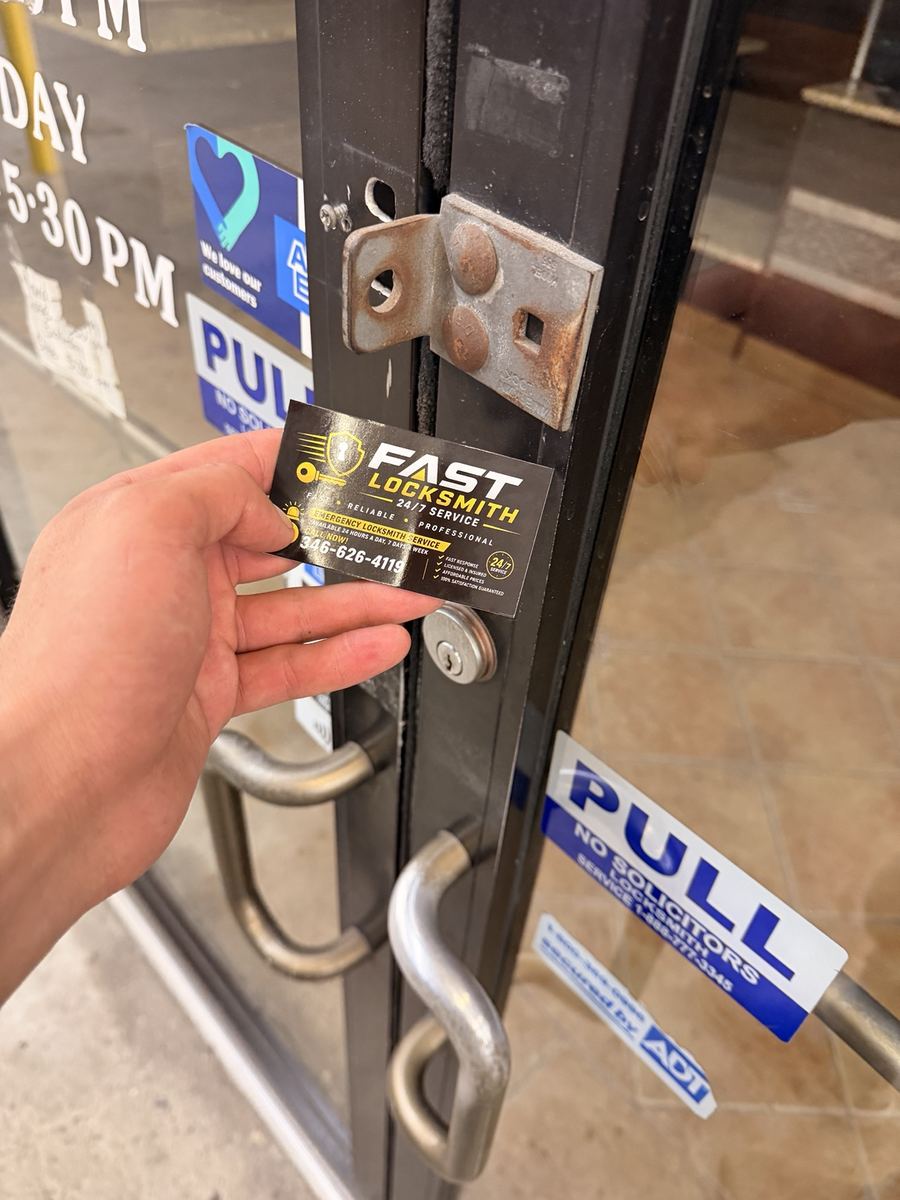
If you're locked out of store with an aluminum storefront door, the lock is a narrow cylinder and a hookbolt inside the stile. Most open with a pick and tension wrench. If the cylinder turns but nothing happens, the cam has failed, and we go in another way, then replace the cylinder.
Locked Out of Office in a Leased Building
If you're locked out of office in a tower or mid-rise, building security may need to let us up. Tell the dispatcher the building and suite, and call the security desk to let them know we're coming.
The Back Door Is Often the Way In
A steel back door with a standard deadbolt is often easier and cleaner to open than a storefront. Make sure at least one owner or manager has a key to every exterior door, not only the landlord.
The Drill Stays in the Van Unless It Can't
Drilling is a last resort, used when a lock can't be picked or bypassed.
Emergency Commercial Locksmith After a Break-In
If the lockout follows a break-in, call the police first. Then an emergency commercial locksmith can secure the door, repair the frame and rekey if keys are missing. See emergency locksmith.
Proof You're Authorized
Photo ID plus a lease, business license or utility bill in the business's name. A manager can be authorized by the owner by phone. We won't open a business for someone who can't show they're allowed in.
Storefront Lock Repair After the Lockout
Storefront lock repair usually means a new cylinder, a new cam or a hookbolt adjustment. We key the new part to your existing key, so nobody needs a new ring.
Kitchens and Grease-Clogged Cylinders
Commercial kitchens are hard on locks. Exhaust grease drifts out the back door and settles in the keyway, flour dust packs into cylinders, and hoses wash down the doorway every night. A back-door deadbolt in a kitchen can go from smooth to stuck in a year. Spray it with a dry lubricant every few months, keep hoses off the lock, and if the key starts to drag, have the cylinder cleaned before it seizes. Several Energy Corridor caterers we work with put it on the same list as the hood cleaning.
Keys, Copies and Contacts
Give at least two people keys to every exterior door. Keep the landlord's after-hours number in your phone. And when a lock starts feeling loose or gritty, call before it fails at five in the morning.
Reaching Businesses in the Energy Corridor
Where you are in the Energy Corridor decides which technician is sent, and the dispatcher tells you who is coming. Early mornings, strip centers off Dairy Ashford and Highway 6 are quick to reach. Office buildings on Eldridge Parkway take a little longer if security has to escort us. Between about four and seven on weekday evenings, the freeway exits slow everything down.
Technicians Who Get You Open Without Damage
Your technician arrives in uniform and shows ID, checks your authorization and inspects the lock before choosing a method. They work fast but carefully, protect storefront glass and finishes, and explain any failed part before replacing it.
Licensed and insured, Fast Locksmith 24/7 holds 5 stars on Google from Houston businesses.
Commercial Lockout Calls Around the Energy Corridor
Commercial lockouts in the Energy Corridor come from caterers and coffee shops before dawn, clinics before patients arrive, office suites on Eldridge Parkway and around Westlake Park after hours, and shops in strip centers along Highway 6. A commercial lockout in the Energy Corridor often hinges on a back door key nobody has, or a worn storefront cylinder. If you're locked out before opening, call while you still have time. For a business in the Energy Corridor that serves the campuses, the hour before the lunch rush is the one that matters most, so tell the dispatcher when your first delivery leaves.
A commercial lockout in the Energy Corridor might involve a tenant, a landlord and a property manager. Tell the dispatcher who is on site and who can confirm you have the right to enter.
Bring something that shows the space is yours: a lease, a business license, a utility bill or an employee badge.
Mention alarms. Many offices have door sensors, and an alarm company that expects a call can prevent a false dispatch.
If the door is damaged, we assess what is needed to secure it.
Keep a list of who has keys, and the landlord's contact in your phone. In a lockout, those are the calls that speed things up most.
We also handle business lockouts in Memorial, Westchase and Memorial City. For keying plans after staff changes, see commercial locksmith, and for overnight calls, our 24 hour locksmith service.
Estimated Technician Arrival Time
Arrival times vary depending on your location and technician availability.
Actual arrival time may vary depending on your exact location, traffic conditions, time of day, current demand, and technician availability.
Providing your exact vehicle location when calling allows us to give you a more accurate estimated arrival time.